




Insight
An airport’s guide to airside EV charging

Airports are under mounting pressure to decarbonise as the UK’s Jet Zero Strategy and Zero Emission Vehicle mandates accelerate the shift to net zero operations. As airside fleets electrify, airports must navigate complex operational, regulatory and infrastructure challenges to deliver effective EV charging where it matters most - on the tarmac.
Net Zero commitments
The UK Government has set out in its Jet Zero Strategy a commitment to deliver net zero UK aviation by 2050.[1] Within this overarching target, several interim policies have been identified, including the requirement for airport operations in England to be zero emissions by 2040. In addition, the Zero Emission Vehicle (ZEV) mandate defines the pathway to zero-emission vehicles by 2035. This mandate requires 80% of new cars and 70% of new vans sold in Great Britain to be zero emission by 2030, increasing to 100% by 2035. The UK Government has also pledged to reinstate the requirement that all vehicles procured from 2030 onwards must be zero-emission.[2]
An airport’s emissions are categorised into three scopes: Scope 1 emissions arise from sources airports directly own or control; Scope 2 emissions are indirect emissions from energy purchased; and Scope 3 emissions are all other indirect emissions both upstream and downstream. Scope 3 emissions are dominated by aircraft operations but also include tenant activities and third-party ground transport. Airports are required to report their Scope 1 and Scope 2 emissions. While Scope 3 reporting is not currently mandatory for the UK, the EU will introduce mandatory Scope 3 reporting, and the UK Government is in the process of considering its own reporting approach. Scope 3 emissions typically account for most airport’s total emissions and present the greatest challenge to decarbonisation due to their scale and the number of third parties involved.
Taken together, ZEV mandates and evolving reporting requirements mean the aviation sector, and airports in particular, face increasing pressure to decarbonise operations. This places greater focus on airport transport systems, including aircraft, baggage handling vehicles, cars, vans, snow clearing vehicles and emergency response fleets. Airports are well positioned to influence this transition through mandates, ultra-low emission zones and incentives. This article explores the key factors airports should consider to ensure successful EV and charge infrastructure deployment airside.
Understanding the challenges of integrating EVs in an airport
Airport operations can be categorised as either “airside” or “landside.” Landside is the area of the airport where passengers remain until they proceed through the boarding gate to the aircraft. In relation to vehicle locations, an example would be airport drop-off zones. Alternatively, airside encompasses activities and areas at the airport where aircraft operate, which includes the tarmac and runways. To access these areas, often Airside Driving Permits (ADP)[3] are required, enabling authorised vehicles to operate airside in accordance with the relevant airside regulations and permit conditions. ADP’s have varying levels of access to the airside based on the perceived risk of access.
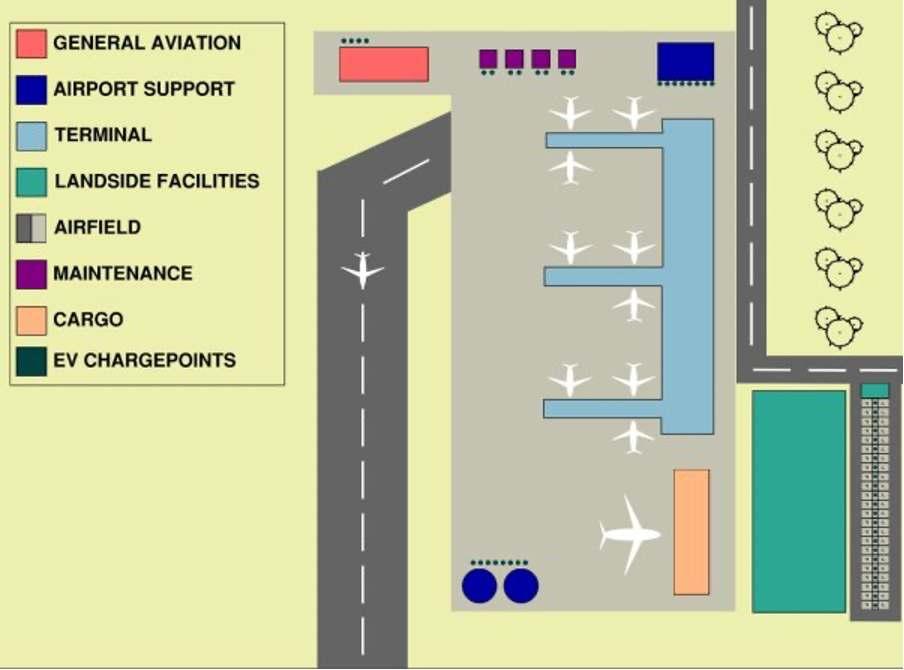
Road infrastructure at airports can be vast and lead to multiple locations. Examples of where vehicles may operate airside are gates, stands and Air Traffic Control (ATC) centres. Airport operations are inherently complex, with multiple stakeholders sharing the same space, diverse vehicle types in use, and movement restrictions linked to each vehicle’s ADP. These factors together make it challenging to determine the optimal placement and deployment of charging infrastructure. An example of locations at an airport is shown.
Figure 1. Breakdown of airport locations
Estimating the Airside EV charging requirements
Airside vehicle fleets include both airport-owned vehicles and those operated by third parties such as airlines, haulage and freight organisations. These vehicles are essential to airport operations and contribute to the airport’s overall emissions profile. While airports may not be required to meet all third-party charging demand, they are likely to need to provide a proportion of charging infrastructure to support operations, meet sustainability objectives and maintain operational resilience.
A necessary step to reduce emissions associated with airside vehicles is to establish a clear baseline level of the vehicles operating airside along with their typical operating patterns, parking locations and dwell times. Identifying airport-owned vehicles is typically straightforward using fleet records and permit data. Assessing third-party vehicle numbers is more complex, but reviewing the airport’s ADP scheme provides a useful starting point by indicating how many vehicles are authorised to operate airside and the areas they can access. While ADP data does not represent daily vehicle volumes, it provides a robust basis for early-stage planning.
Maximising the use of existing electrical infrastructure
Operating, maintaining and upgrading highly secure private networks is a significant challenge over any airport’s large footprint, which requires numerous HV substations and distribution transformers with hundreds of kilometres of cable to keep power flowing day in, day out.
To identify early opportunities for charge point deployment, it is necessary to map out the network capacity of the site along with substation mapping against planned future infrastructure projects. This approach will inform key decision-makers if there are opportunities to realise economies of scale by combining projects, thus reducing costly and disruptive civil infrastructure works across the airport.
Calculating the rate and timeline of charge point deployment is complex, not just at airports but at any sector or site; there is no definitive ‘correct’ solution. However, deployment strategies can be developed based on multiple factors such as an airport’s policies and targets, forecast EV uptake and available network capacity.
Ten steps for developing and maintaining an airside EV strategy
- Engage with key stakeholders: Work with airport fleet managers and third-party operators to understand EV transition plans, parking arrangements and charging expectations.
- Identify the total number of vehicles: Establish an accurate baseline of airport-owned and third-party vehicles using fleet data, ADP records and site observations.
- Vehicle classification: Group vehicles by operational role and duty cycle to simplify analysis and demand estimation.
- Estimate EV transition: Develop transition scenarios and validate assumptions through stakeholder engagement.
- Identify EV equivalents: Review available and emerging EV models or make informed assumptions about future vehicle specifications.
- Estimate the annual energy demand: Calculate charging demand based on vehicle mileage, dwell times and operational profiles, in addition to existing electrical loads.
- Estimate the number of charge points required: Determine the number and power rating of charge points, recognising that some vehicles may require dedicated infrastructure while others can share.
- Identify locations: Identify suitable locations for EV charge points in collaboration with stakeholders and align with planned infrastructure upgrades where possible.
- Estimate investment requirements for each deployment scenario: Assess capital and enabling infrastructure costs for different deployment scenarios.
- Produce recommendations: Bring together locations, costs and operational considerations to support informed decision-making.
Airports face increasing pressure to decarbonise as net‑zero commitments, ZEV mandates and evolving reporting requirements accelerate the need for airside EV adoption, making strategic, data‑driven planning essential despite the complexity of multi‑stakeholder operations and constrained electrical infrastructure. By engaging operators early, establishing a clear fleet and energy baseline and aligning charging deployment with existing network capacity and future demand, airports can efficiently transition to low‑emission operations while maintaining resilience.
[1] Jet Zero Strategy, Delivering Net Zero aviation by 2050, Jet Zero investment flightpath (accessible text-only version) - GOV.UK (www.gov.uk), Accessed 10/07/2024
[2] Change, Labour Party Manifesto 2024, Change Labour Party Manifesto 2024, Accessed 10/07/2024
[3] Requirement for an Airside Driving Permit Scheme, Civil Aviation Authority, CAP 790: Requirement for an Airside Driving Permit (ADP) Scheme | Civil Aviation Authority (caa.co.uk), Accessed: 15/07/2024
Share this article


